Decision-grade audits for high-stakes moments.
Verona brings two decades of accessibility and software risk expertise across e-commerce, government, financial, and healthcare environments, as well as corporate organizations.
We combine AI-assisted discovery with expert evaluation, validation, and defect discovery to deliver decision-grade clarity.
That means clear prioritization, actionable remediation direction, and executive-ready insight for teams and leaders making legal, procurement, brand, and release decisions with real consequences.

Find Your Fit
For Corporations
& Enterprises
You run a corporate or enterprise business with teams to coordinate.
Accessibility exposure is never a problem for just one team. Executives, engineering, and procurement all have a stake.
See How We Work With Teams →For Founders
& Owner-Operators
As the owner or CEO, you carry the decision, the brand, and the risk.
There may be no internal development team or accessibility specialist, so when an issue surfaces, the responsibility lands on you.
Find Out How We Can Help →Risk is rarely hidden.
It is misread.
Principal-led audits and documented risk records built for the decisions that follow.
Automated tools surface signals. We turn them into decision clarity through comprehensive scan coverage, expert evaluation, and rigorous validation. Verona interprets severity, identifies real user impact, and translates findings into clear priorities across releases, procurement, legal exposure, and brand risk. Every engagement is built to deliver a prioritized path teams can execute with confidence.

Risk Readiness Snapshot
Fast, bounded orientation for teams that need to understand whether material accessibility risk exists before committing to a full audit. You leave with a clear risk posture and a direct answer on whether a Core Audit is warranted.
Explore This Service →
Core Accessibility & Software Risk Audit
A rigorous audit combining AI-assisted discovery with hands-on expert interpretation. Findings are prioritized based on user impact, recurrence risk, and business consequence across releases, procurement, and legal exposure. Verona provides engineering-ready remediation guidance that helps technical teams move from issue identification to informed validation.
Explore This Service →
Validation, Documentation & Procurement
Evidence-backed validation and structured documentation for teams preparing for scrutiny. Includes procurement-ready materials, bounded conformance support, and clarity on what your current posture actually supports.
Explore This Service →
Advisory Retainer & Strategic Risk Prevention
Ongoing strategic guidance for organizations that need continuity, not a one time review. We help teams maintain stronger accessibility posture, create documentation prepared for legal scrutiny, and reduce risk drift as systems, functionality, and builds evolve.
Explore This Service →A continuous cycle, not a one time report.
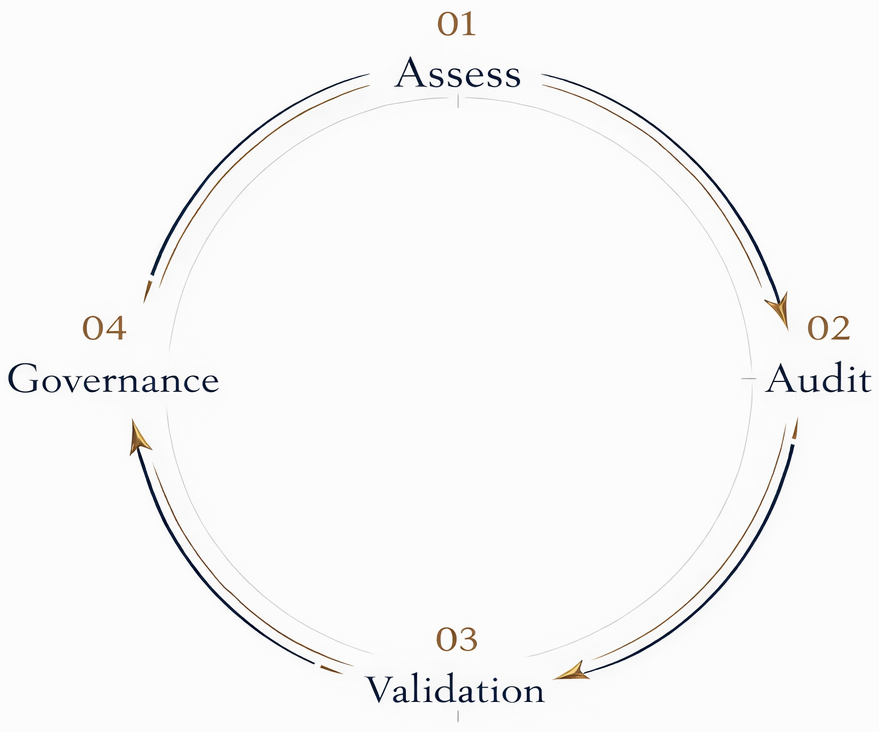
We help businesses obtain initial risk clarity, then move through deeper audit, validation, and ongoing governance. Verona does not stop at identifying problems once. We support executive-level decisions, help teams show and sustain credibility under scrutiny, and maintain a compliant posture through a governed process as systems, functionality, and builds evolve.
You can engage Verona at the point that matches your current need, whether that is a targeted assessment, a full audit, validation support, or ongoing governance.
Regulatory Timeline
The April 2027 ADA Title II web and mobile accessibility rule creates an immediate compliance deadline.
It is a major driver for public entities, and it also increases inherited liability pressure on private vendors supporting government and education.
For public sector contracting, this is no longer a roadmap item or a QA checkbox. It is a license to do business.
With less than a year to get up to date, if you have not started, you are already behind.
The cost compounds long before the crisis.
Accessibility risk rarely arrives as a single, visible failure. It accumulates quietly through unresolved barriers, inconsistent validation, and the assumption that scan coverage alone reflects real readiness. It requires evaluation, validation, and expert interpretation to establish a credible accessibility posture.
By the time it surfaces in procurement, legal review, or a high-pressure release cycle, the cost is no longer theoretical. It shows up as delayed launches, blocked deals, internal friction, and documentation that cannot withstand scrutiny.
When it comes to accessibility, the businesses that weather the storm best are the ones that prepare before scrutiny arises.
Less development time lost. Less money spent.
Less brand damage absorbed.
Figures are sourced and dated in the reference notes.
Risk intelligence for the leaders responsible for what happens next.



Principal-Led. Decision-Grade. Built for Scrutiny.
The findings are in front of you. The next step is clarity.
Verona works with businesses that have a specific decision ahead and need expert-level accessibility risk interpretation to make it.
Prefer to talk first? Schedule a conversation.
No commitment required. We will help you identify your best next step.